
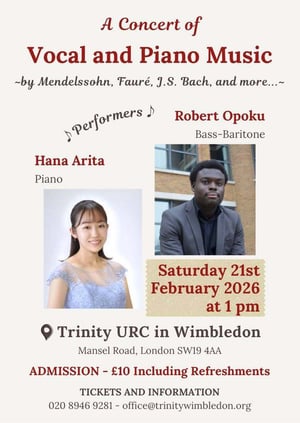
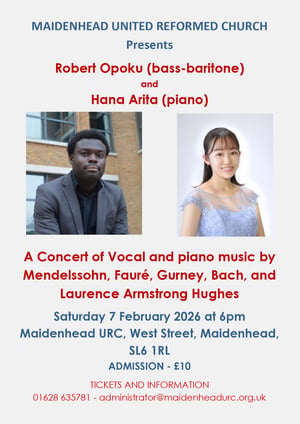
(Click the image to view the full programme notes (the same programme and programme notes were used for both the Maidenhead and Wimbledon recitals))
PROGRAMME
Es ist genug (It is enough!)
From Elijah (Op. 70)
Text by Julius Schubring (1806-1889)
Music by Felix Mendelssohn-Bartholdy (1809-1847)
The Salley Gardens
Text by William Butler Yeats (1865-1939)
Music by Benjamin Britten (1913-1976)
Après un rêve (After a dream)
Text by Romain Bussine (1830-1899)
Music by Gabriel Fauré (1845-1924)
Lights Out
Text by Edward Thomas (1878-1917)
Music by Ivor Gurney (1890-1937)
Partita No. 1 in B-flat Major, BWV 825
J.S. Bach (1685-1750)
Toujours (Always)
From Poème d’un Jour (Op. 21)
Text by Charles Grandmougin (1850-1930)
Music by Gabriel Fauré (1845-1924)
Sleep
Text by John Fletcher
Music by Ivor Gurney (1890-1937)
O du mein holder Abendstern
From Tannhäuser
English translation by Natalia Macfarren (1826-1916)
Music and libretto by Richard Wagner (1813-1883)
Is my team ploughing?
No. 6 from A Shropshire Lad
Text by A. E. Housman (1859-1936)
Music by George Butterworth (1885-1916)
Programme notes
Es ist genug (It is enough!)
From Elijah (Op. 70)
Text by Julius Schubring (1806-1889)
Music by Felix Mendelssohn-Bartholdy (1809-1847)
Es ist genug,
So nimm nun, Herr, meine Seele!
Ich bin nicht besser denn meine Väter.
Ich begehre nicht mehr zu leben,
denn meine Tage sind vergeblich gewesen.
Ich habe geeifert um den Herrn,
um den Gott Zebaoth,
denn die Kinder Israels haben deinen Bund verlassen,
und deine Altäre haben sie zerbrochen,
und deine Propheten mit dem Schwert erwürgt,
Und ich bin allein übriggeblieben,
und sie stehen danach,
dass sie mir mein Lebenehmen!
It is enough!
O Lord, now take away my life,
For I am not better than my fathers.
I desire to live no longer,
Now let me die, for my days are but vanity.
I have been very jealous for the Lord,
For the Lord God of Hosts,
For the children of Israel have broken thy covenant,
And thrown down thine altars, and slain all thy prophets with the sword,
And I, even I only am left,
And they seek my life,
To take it away!
Elijah by Mendelssohn is one of the few 19th century oratorios still performed, having been finished in 1846 and then premiered in the same year in Birmingham. The work consists of episodes from the story of the biblical prophet Elijah: Mendelssohn wrote the piece in German with libretto using sections of 1 Kings, Psalms, and other books of the Hebrew Bible. The work’s first performance used the English version of the text, and the work has since been performed in both German and English, with the German version being performed today. Es ist genug (It is enough), the bass aria, comes in the second part of the work: Elijah begs God to take his life after failing to convert Israel and failing to prevent people turning to false Gods.
It has been widely written about, including by the musicologist Malcolm Bruno, that Mendelssohn’s Es ist genug is notably influenced by J. S. Bach’s Es ist vollbracht from the St John Passion, and this is evident right from the start with the use of descending melodic lines as a way of expressing sorrow.
The Salley Gardens
Text by William Butler Yeats (1865-1939)
Music by Benjamin Britten (1913-1976)
Down by the salley gardens my love and I did meet;
She passed the salley gardens with little snow-white feet.
She bid me take love easy, as the leaves grow on the tree;
But I, being young and foolish, with her would not agree.
In a field by the river my love and I did stand,
And on my leaning shoulder she laid her snow-white hand.
She bid me take life easy, as the grass grows on the weirs;
But I was young and foolish, and now am full of tears.
The Salley Gardens was first published in 1943; Britten uses the melody of on an old Irish folk tune. The poem by William Yeats describes a young man meeting a lady and not heeding her advice to take things easy, and then being filled with regret and mourning the loss of his love. The musicologists Donald Mitchell and Hans Keller wrote about German Lieder playing an important role in Britten’s musical development.
The simple, repeating chord accompaniment in this piece, together with the theme of mourning lost love, might invite a comparison with Schumann’s Ich grolle nicht from his song cycle Dichterliebe, which has a similar repeating chord accompaniment and similar theme of morning lost love. Though the sense of loss is perhaps more implicit in Ich grolle nicht than in The Salley Gardens. A similar comparison might also be made to Fauré’s Après un rêve, as noted above.
Après un rêve (After a dream)
Text by Romain Bussine (1830-1899)
Music by Gabriel Fauré (1845-1924)
Dans un sommeil que charmait ton image
Je rêvais le bonheur, ardent mirage;
Tes yeux étaient plus doux, ta voix pure et sonore.
Tu rayonnais comme un ciel éclairé par l’aurore ;
Tu m’appelais, et je quittais la terre
Pour m’enfuir avec toi vers la lumière ;
Les cieux pour nous entr’ouvraient leurs nues,
Splendeurs inconnues, lueurs divines entrevues.
Hélas! Hélas, triste réveil des songes !
Je t’appelle, ô nuit, rends-moi tes mensonges ;
Reviens, reviens radieuse,
Reviens, ô nuit, mystérieuse!
In a slumber charmed by your image
I dreamed of happiness, ardent mirage;
Your eyes were more tender, your voice pure and clear.
You were radiant like a sky brightened by sunrise;
You were calling me, and I left the earth
To flee with you towards the light;
The skies opened their clouds for us,
Splendours unknown, glimpses of divine light.
Alas! Alas, sad awakening from dreams!
I call to you, oh night, give me back your illusions;
Return, return with your radiance,
Return, oh mysterious night!
Fauré’s well-known Après un rêve (1878) describes a yearning for a lost, dreamy vision, with the dream interrupted by a waking up to reality at the end. The sense of longing for a lost love is a theme that returns later in the programme in Britten’s The Salley Gardens, and the repetitive chord accompaniment in both pieces also perhaps invites some comparison between the two pieces. Though Fauré’s harmonic language in Après un rêve is generally more complex than Britten’s simpler harmonic setting in The Salley Gardens. The acclaimed pianist and authority on French song, Graham Johnson, has written about Fauré and the French tradition and its influence on Britten’s vocal music.
Lights Out
Text by Edward Thomas (1878-1917)
Music by Ivor Gurney (1890-1937)
I have come to the borders of sleep,
The unfathomable deep
Forest where all must lose
Their way, however straight
Or winding, soon or late;
They cannot choose.
Here love ends –
Despair, ambition ends;
All pleasure and all trouble,
Although most sweet or bitter,
Here ends, in sleep that is sweeter
Than tasks most noble.
There is not any book
Or face of dearest look
That I would not turn from now
To go into the unknown
I must enter, and leave, alone,
I know not how.
Lights Out was written by the poet and composer Ivor Gurney in 1919, and set to text by Gurney’s fellow poet, Edward Thomas. Gurney and Thomas both served in the First World War. Edward Thomas died at the Battle of Arras in France in 1917, two years prior to Gurney setting this text to music; the text addresses the end of life and searching for peace, with sleep used as a metaphor for death. This theme of sleep as a metaphor for death was also explored by Schubert and Schumann, and Ian Venables has written about the influence that the German tradition had on Gurney.
The song Rast (Rest) from Schubert’s Winterreise might be compared to Lights Out. Though Lights Out is in a major key and Rast is in a minor key, and though Gurney’s Lights Out is perhaps more complex with the varying number of beats in a bar that Gurney uses, the gentle sense of momentum created by the piano accompaniment together with the shared theme of sleep as a metaphor for death is similar in both pieces.
Partita No. 1 in B-flat Major, BWV 825
- Praeludium, Allemande, Corrente, Sarabande, Menuet I, Menuet II, Gigue
J.S. Bach (1685-1750)
The Partita No.1 starts with praeludium as an introduction which demonstrates the major theme of the piece. After this opening, five kinds of court dances - allemande, corrente, sarabande, two menuets and gigue show a variety of dance styles and forms.
The allemande, the French term for ‘German’ or ‘German dance’, became popular in the French court during the middle of the sixteenth century. Originally, the music was in common time at a moderate tempo and was used as a replacement for the pavane which was a more stately and slow dance. In the seventeenth century, the allemande became faster with fewer beats influenced by German dance and developed its popularity as the first movement in a suite.
The corrente is a lively Italian dance written in a triple meter. In contrast to the French dance ‘courante’ which features more fluency at a moderate tempo, the Italian corrente is characterised by its brisk tempo, swinging rhythm and light-hearted mood.
The sarabande is a slow and stately dance written in either duple or triple meter. It is rooted in early sixteenth-century Spain as a fast dance. However, it was later transformed into a slower and more solemn form as it gained popularity in the French court during the seventeenth century. The dance is known for its emphasis on the second beat. This partita’s sarabande is distinguished by its vocal, decorative melodic writing.
The menuet or minuet is a dance in triple meter and traditionally consists of two distinct sections that are repeated respectively. Originating as a French rural dance, it gradually gained favour among the upper classes and flourished in the court of King Louis XIV. The minuet was introduced as a standard movement in the instrumental suite which spread widely throughout Europe.
The gigue, derived from Irish and Scottish dance ‘jig’, is a rapid dance suite written in compound duple meter which originates from the sixteenth century British Isles. The gigue was introduced as the last movement of a dance suite in the late seventeenth century. The music is characterised by style brisé, or ‘broken style’, referring to the irregular arpeggiated figures that became fashionable among the seventeenth-century French lutenists.
Toujours (Always)
From Poème d’un Jour (Op. 21)
Text by Charles Grandmougin (1850-1930)
Music by Gabriel Fauré (1845-1924)
Vous me demandez de me taire,
De fuir loin de vous pour jamais,
Et de m’en aller, solitaire,
Sans me rappeler qui j’aimais!
Demandez plustôt aux étoiles
De tomber dans l’immensité,
A la nuit de perdre ses voiles,
Au jour de perdre sa clarté!
Demandez à la mer immense
De dessecher ses vastes flots,
Et, quand les vents sont en démence,
D’apaiser ses sombres sanglots!
Mais n’espérez pas que mon âme
S’arrache à ses âpres douleurs,
Et se dépouille de sa flamme
Comme le printemps de ses fleurs.
You ask me to be silent,
To flee far from you for ever
And to go my way alone,
Forgetting whom I loved!
Rather ask the stars
To fall into infinity,
The night to lose its veils,
The day to lose its light!
Ask the boundless sea
To drain its mighty waves,
And the raging winds
To calm their dismal sobbing!
But do not expect my soul
To tear itself from bitter sorrow,
Nor to shed its passion
As springtime sheds its flowers!
Translation by Richard Stokes, author of A French Song Companion (Oxford, 2000)
In Toujours (1878) by Fauré, the protagonist refuses to accept being told by his lover to forget the relationship, lamenting that it would be impossible, and exclaiming that it would be easier, for example, to ask “the day to lose its light” or “the sea to drain its mighty waves”.
We are revisiting the theme of lost love that we had earlier in the programme in Après un rêve and The Salley Gardens. One might compare the rapidly rising and falling piano accompaniment, which provides a bubbling undercurrent throughout this short and seemingly emotional outburst of a song, to the “mighty waves” described in the text. The accompaniment style and general musical language perhaps has hallmarks of Chopin’s Fantaisie-Impromptu, Op. 66; the musicologist Jean-Michel Nectoux, among others, has written about Chopin’s notable influence on Fauré.
Sleep
Text by John Fletcher
Music by Ivor Gurney (1890-1937)
Come, sleep, and with thy sweet deceiving
Lock me in delight awhile;
Let some pleasing dream beguile all my fancies;
That from thence I may feel an influence
All my powers of care bereaving!
Though but a shadow, but a sliding,
Let me know some little joy!
We that suffer long annoy
Are contented with a thought
Through an idle fancy wrought:
O let my joys have some abiding!
Sleep (1914) by Gurney has a theme of longing for an escape from suffering, and of praying for and seeking peace. The theme of sleep as a metaphor for death returns here, we have seen this previously in the programme in Gurney’s Lights Out. Gurney is widely said to have been heavily influenced by the German Romantic tradition; this piece in particular has notable similarities to Schubert’s Nacht und Träume, both in terms of the shared gently sustained and dream-like piano accompaniment which conveys the sense of sleep, and also in terms of the similar theme around longing for a release from suffering.
O du mein holder Abendstern
From Tannhäuser
English translation by Natalia Macfarren (1826-1916)
Music and libretto by Richard Wagner (1813-1883)
Wie Todesahnung, dämm‘rung deckt die lande,
Umhüllt das Thal mit schwärzlichem Gewande,
Der Seele, die nach jenen Höh‘n verlangt,
Vor ihrem Flug durch Nacht und Grausen bangt.
Da scheinest du, O! lieblichster der Sterner.
dein sanftes Licht entsendest du der Ferne,
Die nächt‘ge Dämm‘rung theilt dein lieber Strahl,
Und freundlich Zeigst du den Weg aus dem Thal.
O du mein holder Abendstern,
wohl grüsst‘ich immer dich so gern;
Vom herzen, das sie nie verrieth,
Grüsse sie, wenn sie vorbei dir zieht,
Wenn sie entschwebt dem Thal der Erden,
Ein sel’ger Engel dort zu werden.
Like death’s dark shadow, night her gloom extendeth,
Her sable wing o’er all the vale she bendeth,
The soul that long to tread yon path of light,
Yet dreads to pass the gate of fear and night.
I look on thee, oh, star in heav’n the fairest,
Thy gentle beam through trackless space though bearest,
The hour of darkness is by thee made bright,
Thou leadest upward with pure, kindly light.
Oh, star of eve, thy tender beam
Smiles on my spirit’s troubled dream;
From heart that ne’er its trust betray’d,
Greet, when she passes, the peerless maid,
Bear her beyond this vale of sorrow
To fields of light that know no morrow.
In O du mein holder Abendstern from Wagner’s Tannhäuser (1845), Wolfram prays for the evening star to guide his beloved, now deceased, Elisabeth to heaven as she ascends from the valley of death. The aria is a declaration of love, in the context of a theme of saying farewell and hoping for Elisabeth’s passage to peace. This yearning for peace, albeit in a slightly different context, revisits the theme of longing for peace that has already appeared earlier in the programme in Gurney’s Lights Out and Gurney’s Sleep. The musicologist Carl Dahlhaus compared O du mein holder Abendstern to the style heard in Mendelssohn’s Lied ohne Worte (Song without words).
If one listens in particular to Mendelssohn’s Andante con moto in E major (Op. 19 No. 1) from Lied ohne Worte, one can hear similarities both in terms of the melodic shapes used as well as the harmonic language employed in both pieces.
Is my team ploughing?
No. 6 from A Shropshire Lad
Text by A. E. Housman (1859-1936)
Music by George Butterworth (1885-1916)
“Is my team ploughing, that I was used to drive
And hear the harness jingle when I was man alive?”
Ay, the horses trample, the harness jingles now:
No change, though you lie under the land you used to plough.
“Is football playing along the river shore,
With lads to chase the leather, now I stand up no more?”
Ay, the ball is flying, the lads play heart and soul;
The goal stands up, the keeper stands up to keep the goal.
“Is my girl happy, that I thought hard to leave,
And has she tired of weeping as she lies down at eve?”
Ay, she lies down lightly, she lies not down to weep:
Your girl is well contented. Be still, my lad, and sleep.
“Is my friend hearty, now I am thin and pine,
And has he found to sleep in a better bed than mine?”
Yes, lad, I lie easy, I lie as lads would choose;
I cheer a dead man’s sweetheart, never ask me whose.
In Butterworth’s Is my team ploughing? we hear a dialogue between a dead man and his living friend. There are themes of nostalgia and betrayal, as well as return of the theme of lost love and an overarching theme of longing. The theme of longing is also one we have heard earlier in the programme. Though it is perhaps left to the listener to decide whether the dead man does indeed long for life once more or whether he longs for peace in his death. The simple nature of the music in this piece can be attributed to the influence of traditional folk tunes which Butterworth, as well as his fellow composer and contemporary Vaughan Williams, was known to collect.